
On this page
- carVertical at a glance
- What a carVertical report covers for US cars
- What you find in a carVertical report
- Mileage history: read the dates, not just the curve
- Damage records: separate estimates from repair evidence
- Historical photos: compare the car across time
- Timeline: put an imported car’s story in order
- Other report sections and their limits
- How much carVertical costs in the US
- How you pay for a carVertical report
- What if the report has no historical findings?
- What buyers say about carVertical on Trustpilot
- What carVertical’s own US data shows
- carVertical pros and cons
- How to check a used car in the US
- Is carVertical worth it?
- carVertical report questions
Understand the evidence before you order. This guide explains official sample report sections and turns them into practical questions for a used-car viewing.
Checked on 8 November 2026
carVertical at a glance
carVertical is a vehicle history company from Lithuania that launched its car history register in 2019. Its US site prices reports in dollars and pulls American title data from NMVTIS, next to records from Europe and other markets. The short version comes first; the detail follows below.
- Price on the US site: $34.99 for one report, or $47.98 for three ($15.99 each) with the code CARVIN.
- Payment: credit card or PayPal. Checkout asks for an email address before it shows the payment step.
- Unused reports: valid for six months from the purchase date.
- Report returns: an empty report goes back to your account automatically; for wrong data you can ask within 30 days.
- Trustpilot: 3.7 out of 5 from 24,481 reviews.
- Best for: a second opinion on a US car’s title and odometer, and any car with a past in Europe or Canada.
What a carVertical report covers for US cars
For a car titled in the United States, four parts of the report matter most: the title check, the junk and salvage records, the odometer readings and the recall list. The US sample report names NMVTIS as a data partner. That is the federal title database overseen by the Department of Justice, and the title check covers 69 title brands across the states.
By its own count, the company searches more than 1,000 sources in 48+ countries: state registries, police databases, repair shops, inspection centers, lenders and connected-car fleets. It does not create any of this data itself. When those sources hold little about a VIN, the report will be thin too.
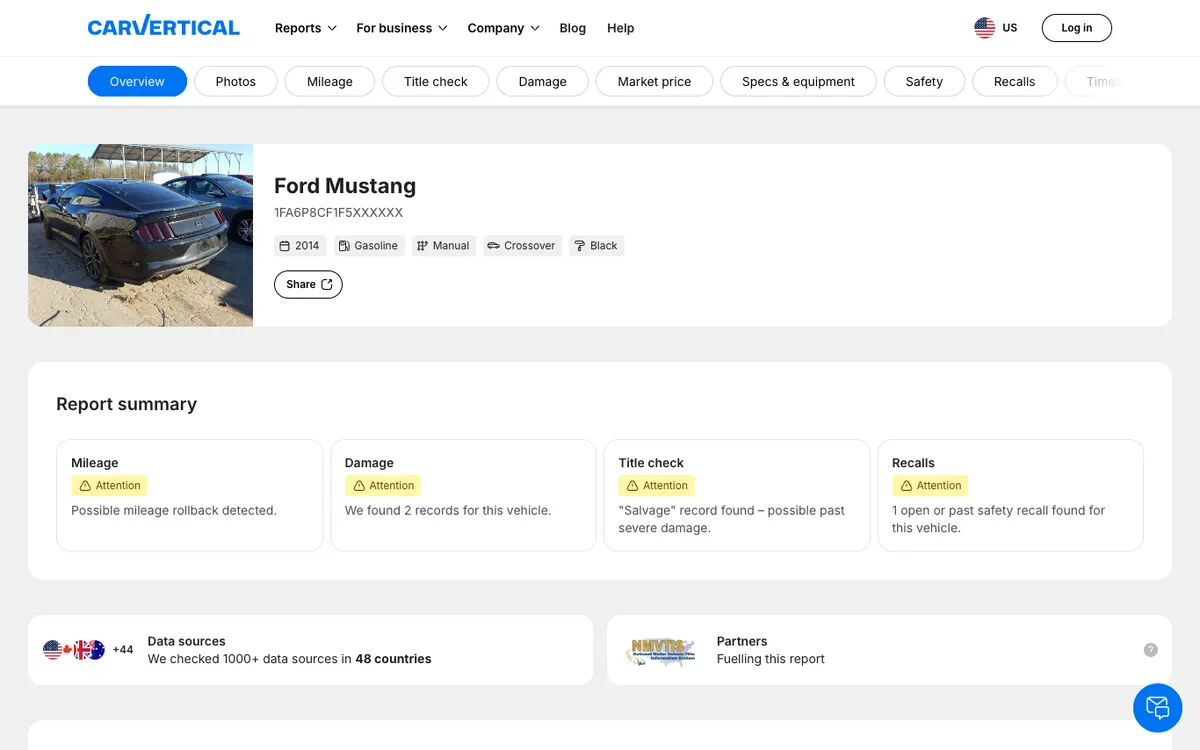
- Title check: brands such as salvage, junk or flood that state agencies put on a title.
- Junk, salvage or insurance records: cars reported by salvage yards, junkyards, or insurers that wrote them off as a total loss.
- Mileage: dated odometer readings, plus an estimate of today’s mileage when the last reading is between six months and three years old.
- Also listed for the US: damage, photos from earlier sales, market price, safety ratings and recalls, emissions, and battery and range data for electric cars.
Source: carVertical US sample report and help centre, read on 8 November 2026.
A visual guide to the report
What you find in a carVertical report
Decide first what you need to know: whether the recorded mileage makes sense, whether the car had earlier damage, or whether an imported car has a documented past. carVertical combines available vehicle records into a report. The sections and depth depend on the individual VIN and the information supplied to the service.
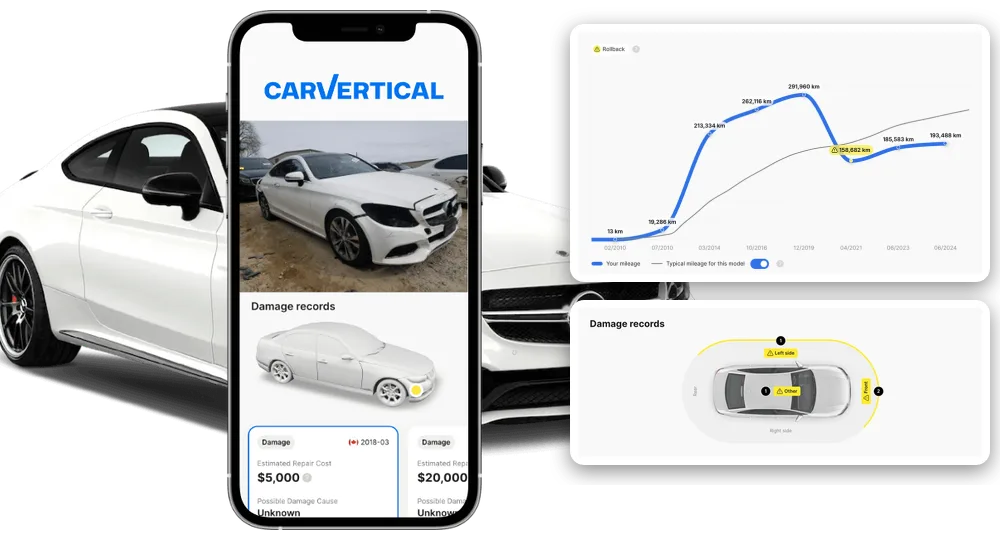
The four examples below are official carVertical demonstration images. They illustrate the interface and the kinds of records you might encounter; they are not a report purchased or independently tested by TopVINDecoder. Your vehicle’s results can be different.
Source: Official report features.
01 / Recorded odometer readings
Mileage history: read the dates, not just the curve
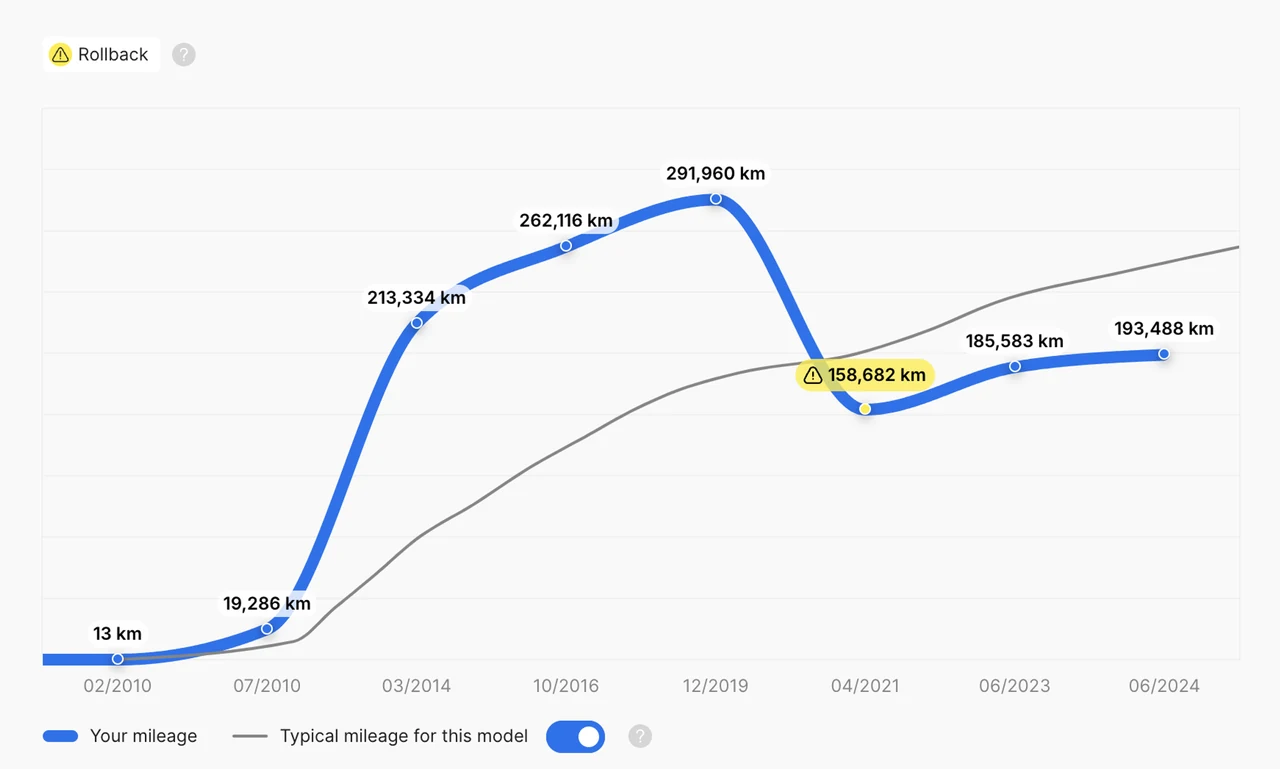
The mileage section brings together readings recorded at different times. It does not read the dashboard live: the latest entry can be older than the mileage you see during a viewing. Check the date and unit of every reading before comparing it with the odometer.
A later reading below an earlier one is a discrepancy to investigate. Gaps also matter, because the chart cannot document journeys or events for which no record was supplied. A rising line is useful evidence of the recorded sequence, but it does not authenticate every kilometre travelled.
Source: How carVertical explains odometer differences.
02 / Earlier damage and assessments
Damage records: separate estimates from repair evidence
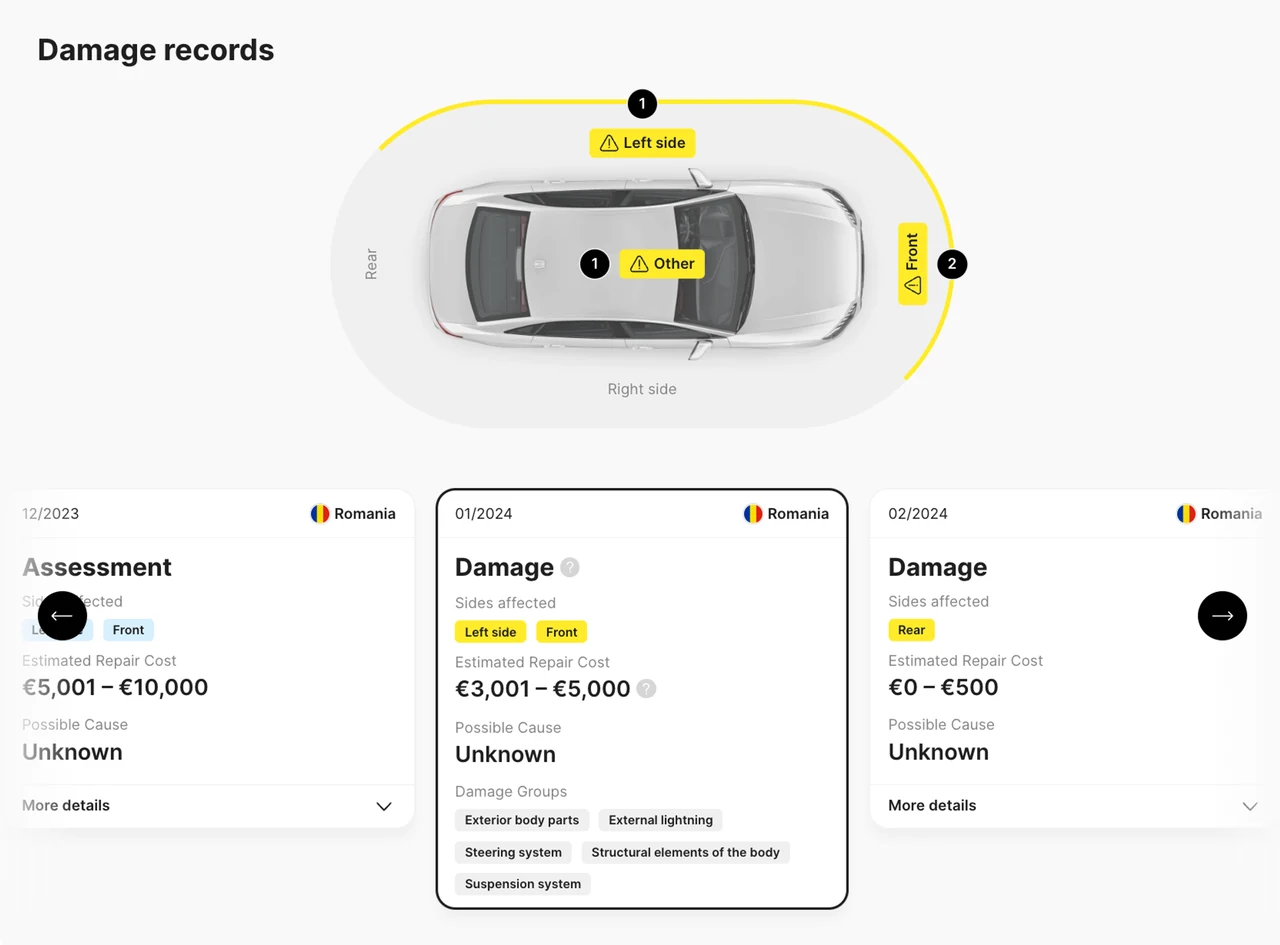
A damage entry can give you a date, location, affected areas and an estimated cost where those details are available. Read the description beside the diagram: a recorded assessment and an actual repair invoice answer different questions.
carVertical explains that valuations can reflect authorised repair-centre prices and the market where the damage was recorded. The amount can therefore differ from what an owner ultimately paid. Neither the estimate nor a diagram tells you how well a vehicle was repaired.
Source: Why damage valuations can differ.
03 / Available images
Historical photos: compare the car across time
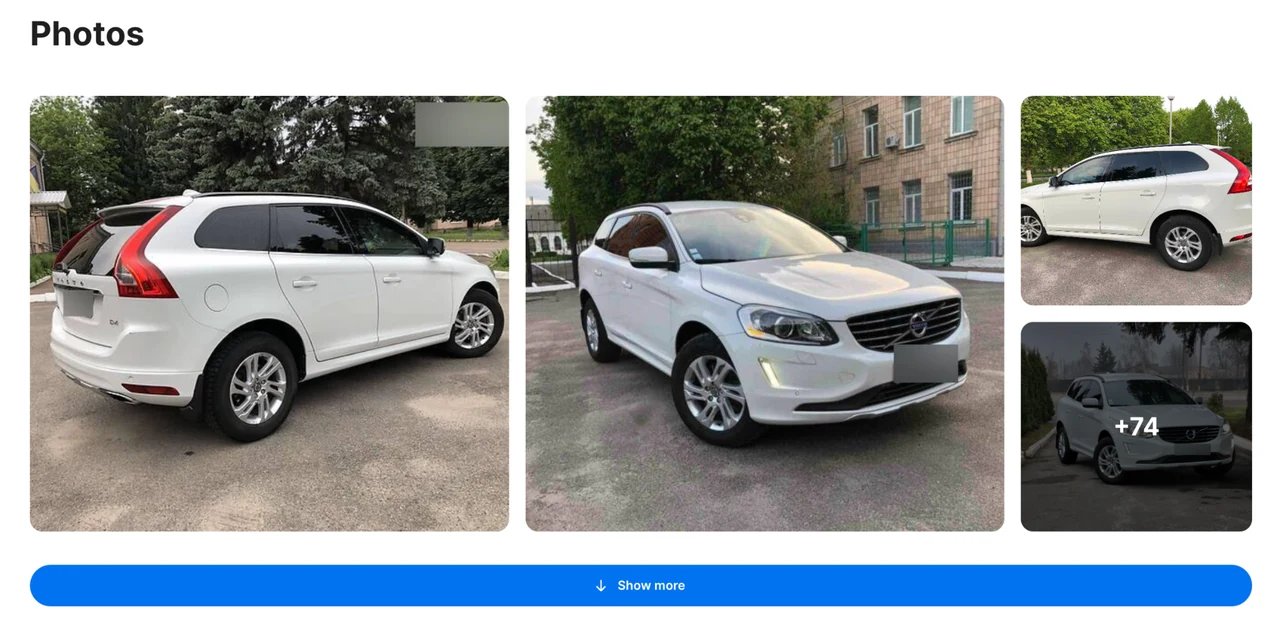
Available historical photographs can add context that a short entry does not convey. Expand the photo section and compare images from different periods rather than judging the car from the first thumbnail. Look for changes worth asking the seller about, including body panels, lights and exterior equipment.
Photos show the angles and condition captured in those images. They do not establish the condition of hidden areas or the vehicle today. An empty photo section means you still need other evidence.
Source: carVertical’s guide to reading report photos.
04 / Dates and countries
Timeline: put an imported car’s story in order
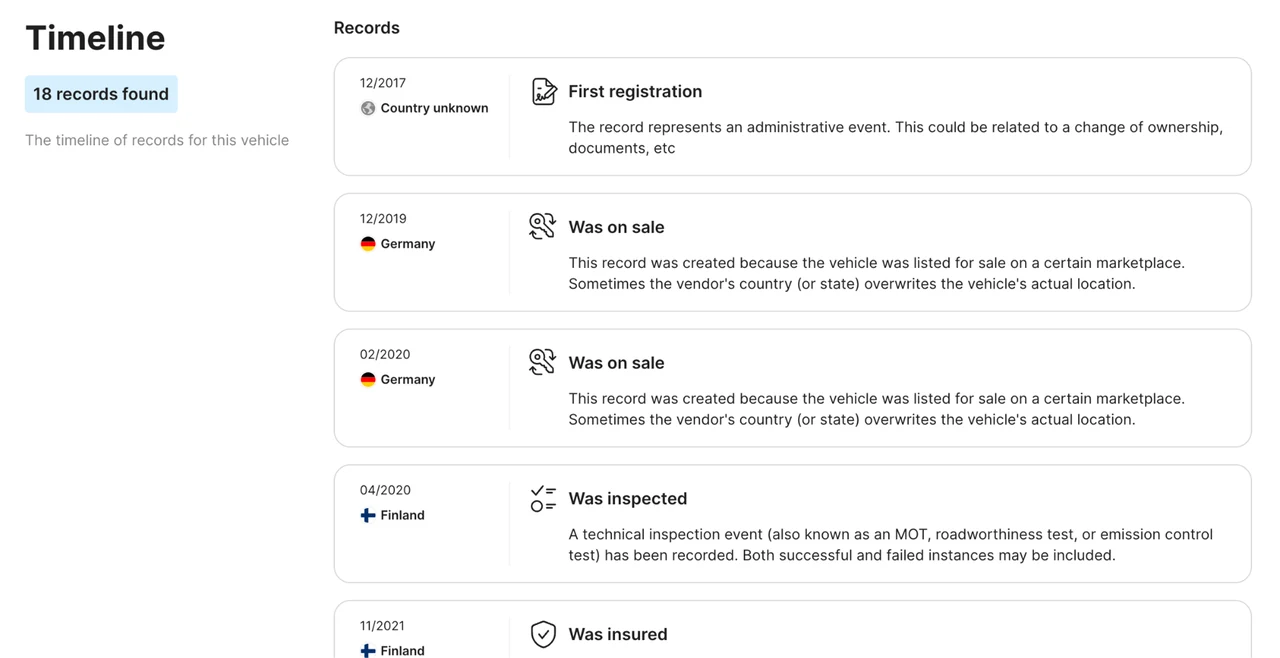
Read the chronological entries alongside the vehicle’s registration papers. They can help you connect dated events and identify periods that deserve more research. For an import, focus on what is actually documented before and after the move between countries.
Also distinguish exposure from confirmed damage. carVertical’s report-reading guide explains that a natural-disaster exposure flag can mean the car was in an affected area; that alone does not establish that the vehicle was damaged.
Source: How to interpret timeline and exposure information.
Other report sections and their limits
Depending on available data, a report can also include theft checks, ownership events, specifications, market-value information, safety recalls and financial or legal entries. Title branding is particularly relevant to vehicles used or registered in the US. These are different checks, so read each section’s scope instead of treating one result as an all-purpose clearance.
- Specifications: compare the listed identity and equipment with the car and documents.
- Market context: use the estimate as a starting point for research, alongside condition and comparable listings.
- Theft, title and restrictions: examine the jurisdiction and dates represented, then resolve outstanding questions with the appropriate official source.
Source: Official explanation of possible report sections.
How much carVertical costs in the US
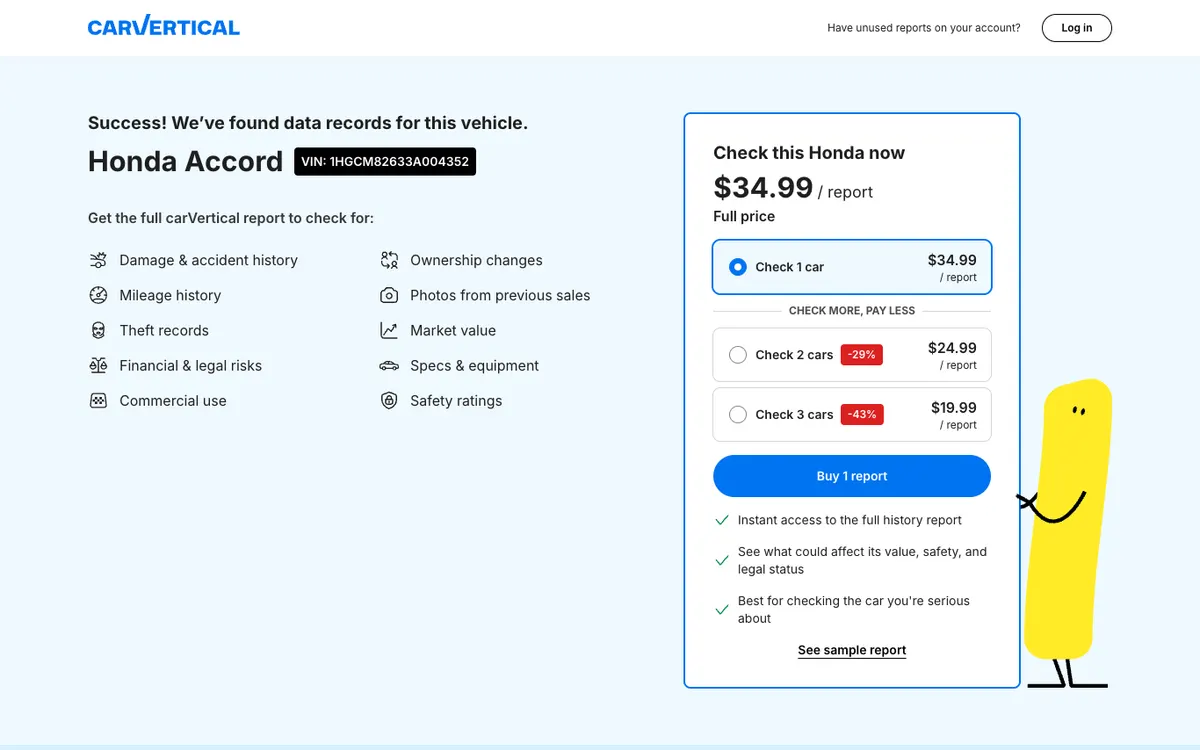
We read these prices on carVertical’s US pages on 8 November 2026. The first column already includes the bundle discount carVertical shows on its own site. The second column is what the same page showed after we applied the code CARVIN, which takes another 20% off.
| Package | Regular price | With CARVIN |
|---|---|---|
| 1 report | $34.99 | $27.99 |
| 2 reports | $49.98 ($24.99 each) | $39.98 ($19.99 each) |
| 3 reports | $59.97 ($19.99 each) | $47.98 ($15.99 each) |
You don’t need a VIN to buy a bundle. The reports wait in your account for six months, so a three-pack only pays off if you expect to look at more than one car in that time. Readers outside the US may land on carVertical’s English European site instead, where the same three-pack cost €43.18 with the code on the same day. When and how to use the code is on our carVertical discount page.
Source: carVertical US pricing page and VIN precheck, read on 8 November 2026.
How you pay for a carVertical report
The pricing FAQ names two ways to pay: credit cards and PayPal. Some older write-ups about the company mention paying with crypto tokens. Nothing on carVertical’s current pages offers that, so plan on a card or PayPal.
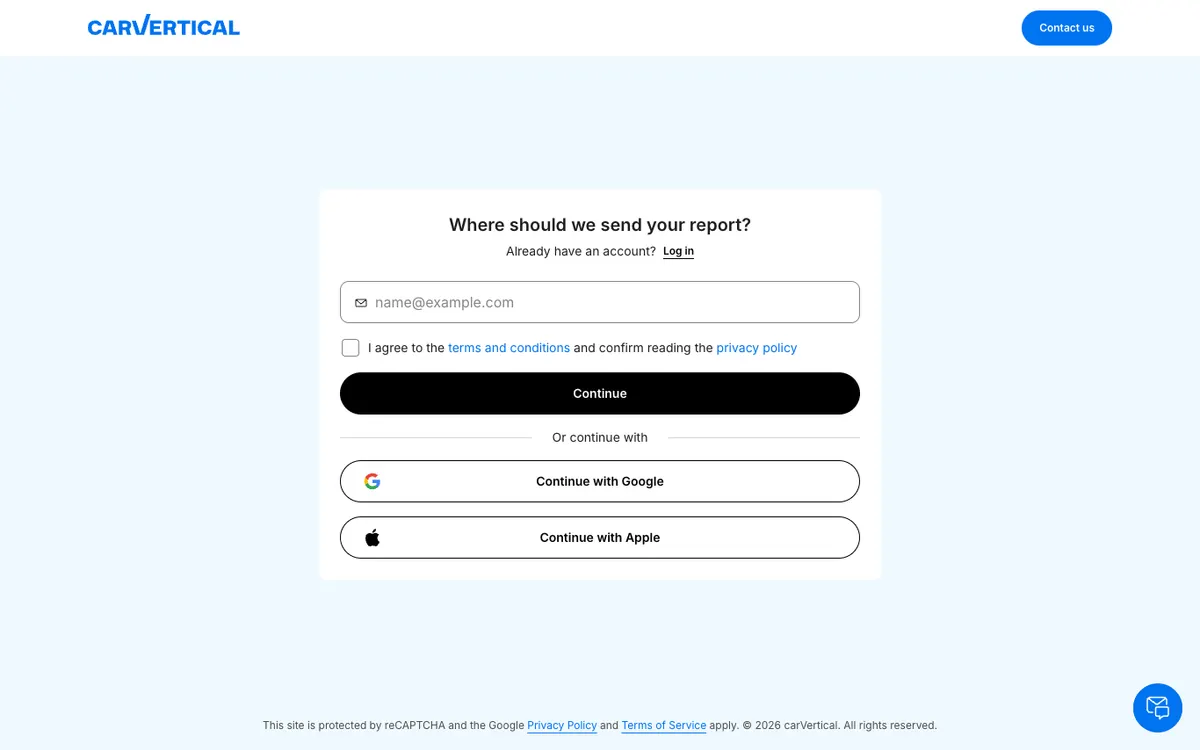
Before the payment form appears, checkout asks where to send the report. You can type an email address or sign in with Google or Apple, and you tick a box to accept the terms. That email becomes your carVertical account, which is created for you after the first purchase. A single report is generated right after payment and also arrives by email; bundle reports sit in the account until you enter a VIN.
Source: carVertical pricing FAQ, checkout and help centre, read on 8 November 2026.
What if the report has no historical findings?
A report counts as “no-findings” when the mileage, damage and timeline sections are all empty: no odometer readings, no damage entries and no events such as registrations, sales or inspections. Check the VIN you typed before anything else, because one wrong character gives exactly this result.
An empty report goes back into your account automatically, and you can use it on another car within six months of the original purchase. If the report has data that you believe is wrong, or it never arrived, the report return policy lets you ask for a return within 30 days of generating it. Email support with the VIN, the purchase date and a short description of the problem. The policy talks about returning reports to your account; it does not promise money back to your card.
Source: carVertical report return policy and help centre, read on 8 November 2026.
What buyers say about carVertical on Trustpilot
On 8 November 2026 carVertical had a TrustScore of 3.7 on Trustpilot, from 24,481 reviews, 7,281 of them written in the last twelve months. Opinions are split: 44% of reviewers give five stars and 33% give one star, with few in between.
The happy reviews usually describe a report that exposed a wound-back odometer or old bodywork the seller kept quiet about. The unhappy ones come back to a few themes. Some find the price too high or saw bundle reports expire unused; others got little data for an imported car or dispute a damage entry. Many recent reviewers are in the UK or elsewhere in Europe, so treat the score as a view of the service as a whole rather than of its US coverage. The company replies to nearly every negative review, usually within a day.
Source: Trustpilot page for carvertical.com, read on 8 November 2026.
What carVertical’s own US data shows
Every year the company publishes a used-car transparency index built from the reports its customers buy. In the 2026 edition the US ranks 12th of 23 countries. Of the US cars checked, 4.2% showed a rolled-back odometer, and those rollbacks hid 46,898 miles on average. 45.56% had at least one damage record, and the typical car checked was 11.46 years old.
A recall study from January 2025 used reports bought between January 2023 and September 2024. It found recall records on 3.2% of US cars, one of the lowest shares among the 26 countries covered. It only counts what showed up in reports, so the free NHTSA lookup is still the place to see whether a recall was actually fixed.
Its “junkyard reports” show what a messy US history looks like. A September 2026 story follows a 2018 Nissan Titan. After a crash in June 2025 it received a salvage title and a “Not Actual” odometer brand, and two months later it was vandalized. Brands like these stay with the title record. A car can look tidy at the viewing and still carry them.
Source: carVertical used car market transparency index (US, 2026) and carVertical blog, read on 8 November 2026.
carVertical pros and cons
What we like
- US title brands and junk or salvage records, with NMVTIS named as a source.
- One report searches every country carVertical covers, which helps with a car that came from Canada or Europe.
- A mileage chart with an estimate of the current reading.
- The free precheck tells you whether any records exist before you pay.
- Empty reports come back to your account without a request.
What to watch
- $34.99 for a single report without a bundle or code.
- Bundle reports expire six months after purchase.
- The precheck doesn’t say which sections hold data.
- Returns come as reports, not money, and disputes must be raised within 30 days.
- Trustpilot ratings are split, with a third of reviews at one star.
How to check a used car in the US
A paid report is one step. The checks below are free or cheap, and some of them cover things no history report can.
- Match the VIN on the dashboard, the driver’s door jamb and the title. If they differ, stop there.
- Enter the VIN in NHTSA’s recall lookup. It shows unrepaired safety recalls for vehicles from the manufacturers that report to it.
- Run it through NICB VINCheck. This free search shows cars reported stolen and not recovered, or reported as salvage or flood-damaged by member insurers. You get five searches a day.
- For title brands from every state, an NMVTIS report from a provider approved on the official NMVTIS site is the reference. The same system appears among carVertical’s sources.
- At a dealer, read the Buyers Guide on the window. The FTC requires it, and it tells you whether the car is sold as is or with a warranty.
- Pay an independent mechanic for a pre-purchase inspection. It is the only check that looks at the car as it is today.
Buying online or from another state leaves you fewer chances to spot trouble in person, so the report and a remote inspection count for more there.

Is carVertical worth it?
For a buyer in the US, carVertical works best as a second opinion. Title brands, salvage records and the odometer chart cover the problems that cost the most money, and the free precheck saves you from paying for an empty report. At $15.99 a report in the three-pack with CARVIN, it costs less per car than a single EpicVIN report and more than VinAudit. If the car ever lived in Europe or Canada, the multi-country search is the main reason to choose it.
Compare it with CARFAX and AutoCheck, or read our carVertical vs CARFAX comparison. The code and package advice are on the carVertical discount page.
- Before ordering: match the VIN on the vehicle with the documents and identify earlier registration countries.
- Before paying: confirm the total charge, currency, number of reports and current regional terms. Our displayed prices are static snapshots.
- Before buying the car: reconcile discrepancies, review repair evidence and arrange an independent inspection.
Before you choose
carVertical report questions
Does every carVertical report contain photos?
No. The provider includes historical images when they are available for the vehicle. The demonstration gallery is an example, not a promise about a specific VIN.
Can a report tell me the car’s current mileage?
It shows historical readings supplied by data sources. Compare the date of the latest entry with the dashboard and the vehicle’s documents; it is not a live odometer check.
Does a damage estimate show what the owner paid?
Not necessarily. The provider explains that the valuation can use authorised repair-centre rates in the country where damage was recorded. Ask for actual invoices and repair evidence.
Does no damage found mean the car is accident-free?
No. A result describes the records available to the service. It cannot exclude unreported events or replace a physical inspection.
Is the lower displayed price for one report?
No. On carVertical’s US site, $15.99 is the per-report price in the three-report pack with the code CARVIN ($47.98 in total). One report costs $27.99 with the code and $34.99 without it. On the English European site the same pack is €43.18, or €14.39 a report. The basket total is what you pay. Prices checked on 8 November 2026.
How can I pay for carVertical?
By credit card or PayPal, according to carVertical’s pricing FAQ. The payment step comes after you give an email address or sign in with Google or Apple.
How long do unused carVertical reports last?
Six months from the purchase date. That applies to bundle reports and to reports returned after a no-findings result.
Can I get my money back from carVertical?
The policy covers returning reports to your account rather than refunds to your card. Empty reports come back automatically. For wrong data or a report that never arrived, email support within 30 days of generating it.
Does carVertical work for cars from the United States?
Yes. The US site checks state title brands such as salvage, junk and flood, and its sample report names NMVTIS as a data partner. How much you get still depends on the records that exist for that VIN.
Can I use a carVertical report in court?
No. carVertical says its reports are not legal evidence. Use the report to decide and to negotiate before you sign.
Make the report part of a complete check
Use records to prepare better questions, then check the actual vehicle.
Get the viewing checklist Compare carVertical and CARFAXLimits to keep in mind
- An empty damage section does not prove accident-free history
- No-findings report credit recovery has eligibility conditions
- Prices and bundles vary by market
Sources and further reading
- NMVTIS: information for consumers (external website)
- NHTSA: check for recalls by VIN (external website)
- NICB VINCheck (external website)
- FTC: buying a used car from a dealer (external website)
Editorial source review: 8 November 2026. Availability, access rules and terms may change. No vehicle report or paid purchase is implied by this date.